Updated
Pulse sealing or heat sealing: which is right when
Conventional heat sealing uses permanently heated bars and a wide process window, ideal for laminates. Pulse sealing heats only at the moment of sealing and cools actively afterwards. That is mandatory for mono-material PE and Tyvek, where a few degrees decide between a seal and scrap.
Conventional heat sealing
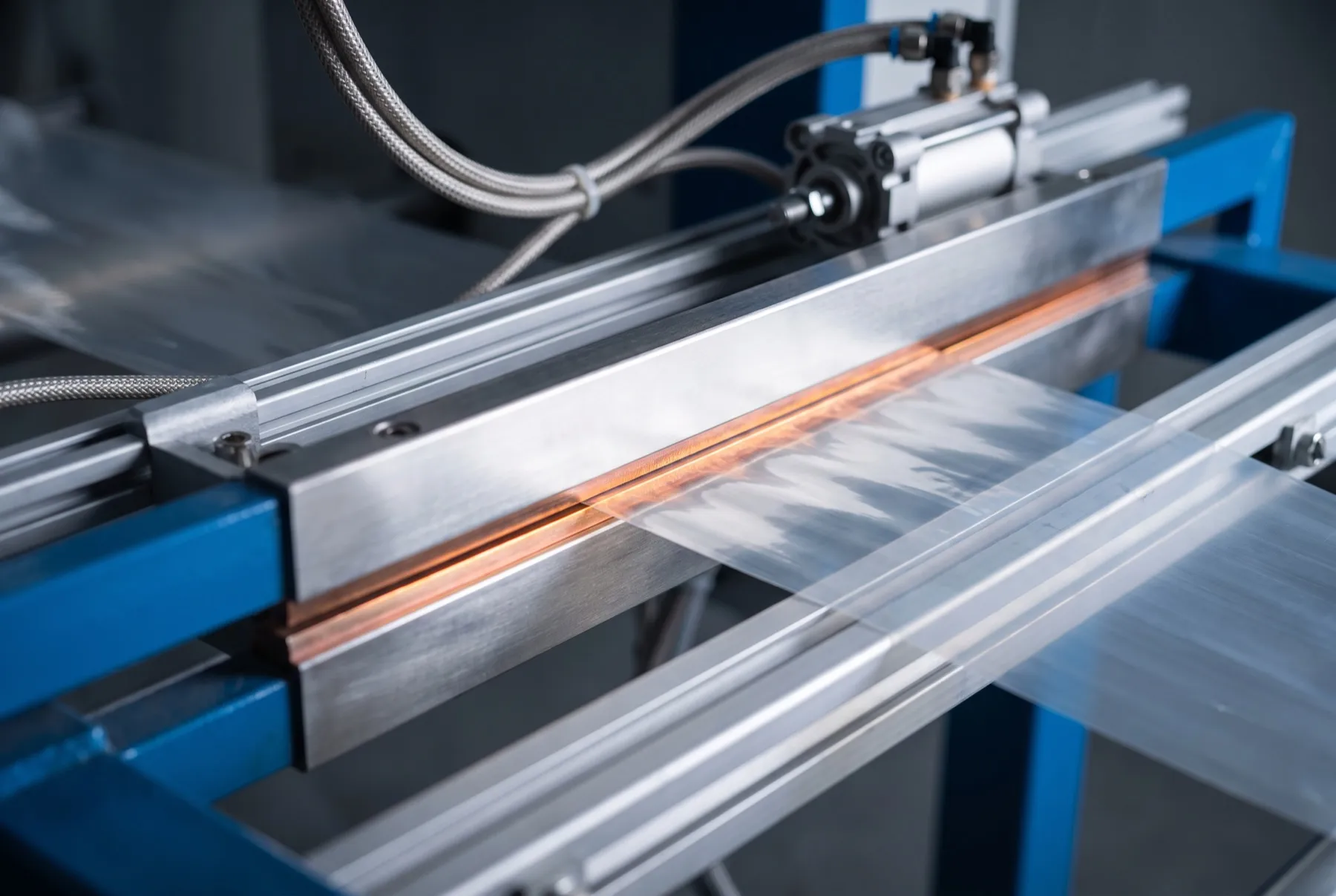
The sealing bars are permanently at temperature. The bag enters, the bars close, the sealing layer melts, the bars open. Simple, robust, rarely troublesome.
The price: actual joining temperature varies with cycle time, ambient temperature and film thickness. For laminates that is uncritical because the process window is several degrees wide. Operational drawback: after switching on, the machine has to warm up.
Pulse sealing
Here heat is applied only at the moment of sealing. In the DLP series Intelligent line that is about 0.85 seconds to 150 °C, then active cooling to 60 °C in roughly one second. The seam solidifies under pressure instead of being released while hot.
The result is a defined, repeatable temperature profile rather than a fluctuating average. There is also no warm-up time at start-up because there is no continuous heating.
When pulse sealing is mandatory
Two material classes leave no choice:
- Mono-material PE: sealing and carrier layer share the same melting range. A few degrees too many mean melt-through.
- Tyvek: the HDPE spunbonded material fuses when overheated and loses gas permeability. Sterilisability is then gone.
- Very thin films: at low material thickness the seam tolerates no temperature drift.
When heat sealing is sufficient
For laminates with a PET or BOPP outer layer and PE sealing layer the process window is wide enough. For stand-up pouches, 4-side-seal bags and vacuum bags from laminate, conventional heat sealing is the more economical solution.
The DLP series is divided exactly along that line: the classic line covers laminates, the Intelligent line mono-material and Tyvek.
Comparison at a glance
Heat sealing: wide process window, simple technology, warm-up time at start, laminates. Pulse sealing: narrow process window manageable, no pre-heating, recipe-capable, mono-material and Tyvek, at higher cost in control and tooling.
The decision is not made on technology but on material. Once the material is fixed, the method follows.
Frequently asked questions
Can one machine do both methods?
- In practice a machine is designed for one method because sealing tools, cooling and control are matched to it. Converting later is not economical.
Is pulse sealing slower?
- The sealing cycle includes a cooling phase, which can lengthen the individual cycle. In return there is no warm-up time at start and less scrap from temperature drift. Net difference depends on the application.
Why does cooling under pressure matter?
- A seam released while hot can distort or pull open before the material solidifies. Cooling under pressure fixes the seam in the geometry in which it was sealed.